Optimising Gold Dust: Are we still shaping the conversation? Or are we learning to speak only in ways that algorithms reward?
- 20 hours ago
- 5 min read
Optimisation. It's a word. I haven't found it in the Bible yet — except, perhaps the Tower of Babel. Bricks. Uniformity. Hmm.
It's about tuning things so they supercharge the output potential, even if they lose the input of important things that were never about supercharging or output.
When I started learning copywriting it was one of the things I was taught, of course. (Even saying shows that I'm 104 years old. Didn't grow up thinking like this.) So here's my starting point.
What happens when optimisation doesn't just shape the writing, but how the writer thinks in the first place. What they bother to count as significant. Or even, what they're advised to sideline and eject from their work.
It's one thing, trying to line up your social media profile with the images of the rich, famous and successful. That's human nature.
But it's another thing entirely if or when every single thing we say becomes shaped and tailored around algorithms.
Let's say to make things more efficient and cost effective, we design automated systems to tell us which posts are the most relevant. It's clear that we better start tailoring our posts to match what scores more highly, because otherwise how can we compete?
Then let's say that we start teaching others that this is the way things are done these days — teaching others who may not have learned their own voice yet, or how to have confidence in using it.
Perhaps like having cosmetic surgery before you've even had a chance to see what your adult body will look like in the first place.
Cosmetic language surgery.
(I know that's not a thing. I'm thinking aloud.)
If that's taking place on a wide scale, then what about our thinking too? We'd be kidding ourselves if we didn't think our thoughts were being affected by the ways we were learning to speak and write these days.
Cosmetic brain surgery.
(That's even less of a thing. Even the metaphor isn't quite right. But still thinking aloud.)
Everyone knows that a blog post worth its salt will be optimised for SEO. Actively tuned into the algorithmic priorities. What is the point otherwise. Might as well chop out everything else…
Don't follow us, we're lost too.
That was a hilarious bumper sticker — all the rage back in the eighties.
If that slogan became a vision for someone's social media empire it would (presumably) be a failure.
You want followers, don't you? You certainly don't want to sound lost. That seems important for launching out into the contemporary world as if you have something to say.
Hmm.
Jesus wanted followers didn't He?
There. (Contemporary relevance, smooth segue, on topic.)
Except the time when someone asked to follow Him and He said, go home.
Okay. That's relevant. Followers here mean something different than fans.
As for 'We're Lost Too!' Jesus wasn't lost.
You know the way that leads to the place I am going.
Do we? (they asked, with a clueless look on their faces.)
His followers were following Him, they just weren't — following him.
Aha. Following, following…
You KNOW me.
He said.
You've SEEN me.
For Jesus it wasn't about bullet points and getting likes.
More like a ballistic heart-directed privately viral encounter.
MmPWRrrrccczgggHhhhzzzzz...!!!
(cloud-of-smoke-invoking hand gestures required.)
— or something.
(That was me trying to spell encounter phonetically)
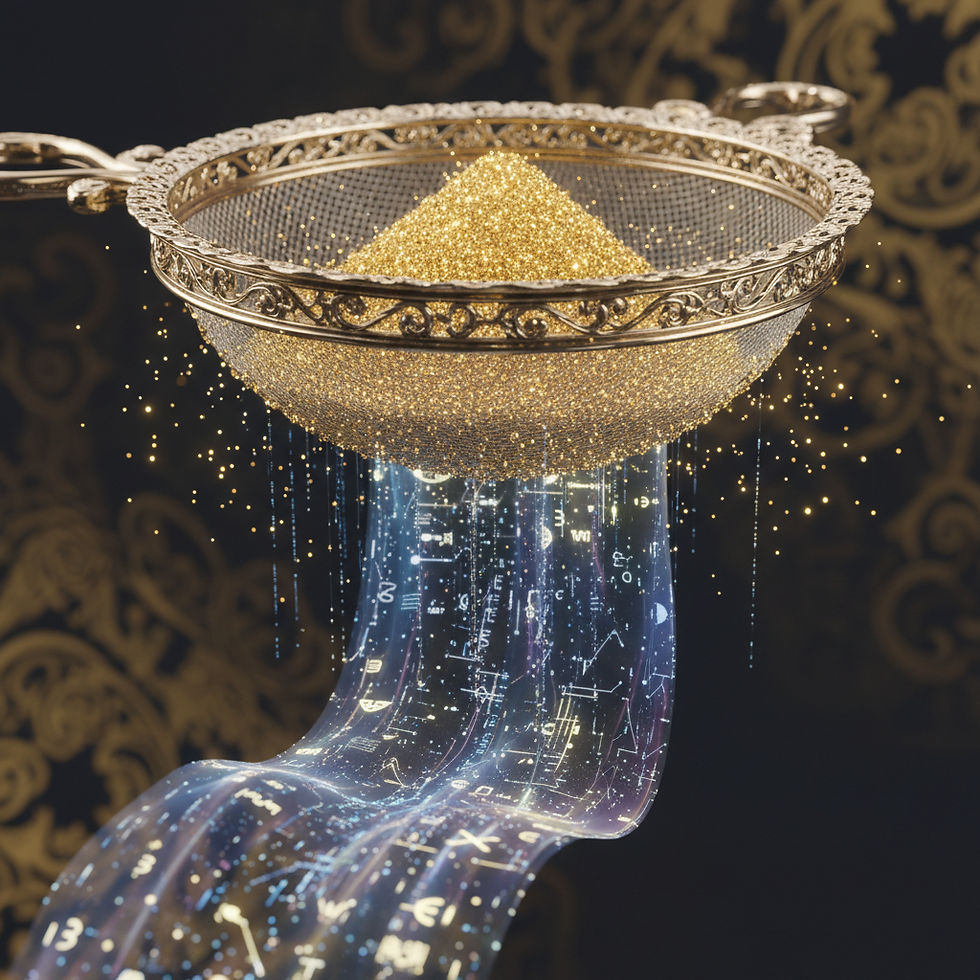
So now let's talk about the gold dust that algorithms don't trade in.
Define Gold Dust:
gold dustnoun | /ˈɡəʊld dʌst/
1. Very small particles or fine powder of gold. Example: “The jeweller's assistant brushed the gold dust from the workbench, wondering if there was a way to sell it on eBay.”
2. Informal Something considered extremely valuable, rare, or desirable. Example: “That information is gold dust to the researchers, but trying to collect it in a bucket for your Etsy store is a whole other matter.”
Origin: From gold + dust, referring literally to finely divided particles of gold. The kind of thing that used to be more valuable than algorithms.
Here are ten examples of what I'm calling gold dust — the stuff that's not crammable into an optimised post. (Coincidentally they are the kind of thing my writing trades in, probably above all else.)
Unexpected connections
Example: That gets me thinking about…
(Can't link that to other related posts because it's just too tenuous.)
Slow thinking
Example: You know, I just can't help feeling that…
(Get to the point. People need to see the point in twenty seconds. Preferably two.)
Uncertainty or ambivalence
Example: uh, um. Hmm. I'm really not sure about…
(What exactly are you saying? Are you actually paying hosting fees to think aloud?!)
Obscure references
Example: This takes me back to a really old story I was told by a stranger I met on the bus who also had a strong interest in the theopoetic trajectories found in everyday dynamics.
(Niche. Nobody cares. Absolutely no one.)
Quiet responses
Example: That stirs me, but I'm not about to post about it.
(Oh, well if it's not even going online, it's not a thing. Why are we even mentioning it?)
Encounter
Example: Wait — wha… THIS EXACT…mo…men…t… uuaahhh!
(Hello? [knock, knock] This is a screen. We need data, not just sound effects.)
Unfinished
Example: Well, I'm not quite ready yet to say this in full but I'm getting there.
(Time is money. Be quiet until you have something concrete and computable. Next?)
Non-instrumental
Example: This has nothing to do with anything at all but hmmm...
(Well, where's the profit in that? Move over and let something make actual use of this space.)
Irrelevant now, even if it's relevant later
Example: Mark my words…
(Meh. We'll see.)
Conscious decision not to bother publishing it publicly
Example: [Tumbleweed]
(No comment possible)
I call these things gold dust because in person they're exactly the kinds of thing that make for wonderful conversation and enriched human interaction.
Even now.
But the more we're online, the more we —
forget?
Even worse — teaching and training new thinkers, speakers, writers and breathers toward language that doesn't value the gold dust.
Imagine.
And then these questions.
What happens to the unmeasurable, and unrewarded gold dust?
What happens to language, thinking etc when that gets filtered out?
What about new generations subjected to the automation of undusted conversation and exploration.
These are questions this site wants to know.
Needs to know.
Also,
Is there a closing window.
A time limit?
Are new generations of humans and thinkers and writers and people losing the currency of gold dust, and optimising language and lives for the rewards of — ?
Hmm.
Babel.


