Notes on Trust, Contingency and Chapter Seventeen
These are notes towards Chapter Seventeen, a practice-based theological project exploring relational faith, trust, contingency and the structures that shape human encounter.
1. Relational Faith
Christian faith isn't merely a list of things to believe.
Nor just an affiliation.
It is, at its heart, an encounter. A relationship.
Not a static one, either. Lived encounter.
With God, with people, and with one's own identity:
Minds being renewed.
Hearts being softened.
Enduring and persevering in a million ways.
2. Trust
And so trust is not just an ice-breaking exercise in falling back blind into a waiting crowd of arms, to see if they will catch you.
It's the capacity to hold in tension what is known and what is unknown.
What can be controlled and what cannot be.
Faith is risk.
Uncertainty — or rather, certainty that doesn't sound logical.
3. Institutions
Governance is often very good and necessary.
Containment and expectation. Marriage, for example.
Keeping vital things protected so that very good things can become possible.
4. Opportunity Cost
Sometimes what happens is that institutions, for all their worth, can make some other things harder to see, or easier to ignore.
We might end up assuming that the shape and boundary of an institution becomes its whole description — those words, those rules.
Vows make possible and determine what's held well.
But the same rules may prevent certain things from being seen or discussed.
You could be abiding by the letter of the law, but without devoting yourself to the spirit of it.
Yet, as long as the rules are kept — there's your defence.
In church too, perhaps. Structures and creeds. Good works. Big effort.
But then, as Nicodemus started noticing, that can leave you ignoring or undermining what's happening in plain sight that's worth noticing.
5. Scaling up
Two people. Twelve people. A thousand people.
Three hundred thousand, four hundred and two people.
Now we need patterns to make it manageable.
Categories: This kind of thing, that kind of thing, the third thing.
Policies: For when this, or that, or the third thing happens.
Procedures: We'll do X when Y happens, so that Z.
That implies (working backwards) every single thing has to be seen as a kind of thing that is either this or that or the third kind of thing.
Like herding cats.
The ones that purr a lot. Over here.
The ones that purr sometimes. Over there.
The ones that never purr. In the third box.
But what happens if the cat was purring because it was being herded.
Or if it wasn't purring because it was unwell.
Or what if that wasn't a purr at all. The cat was a dog. Or whatever.
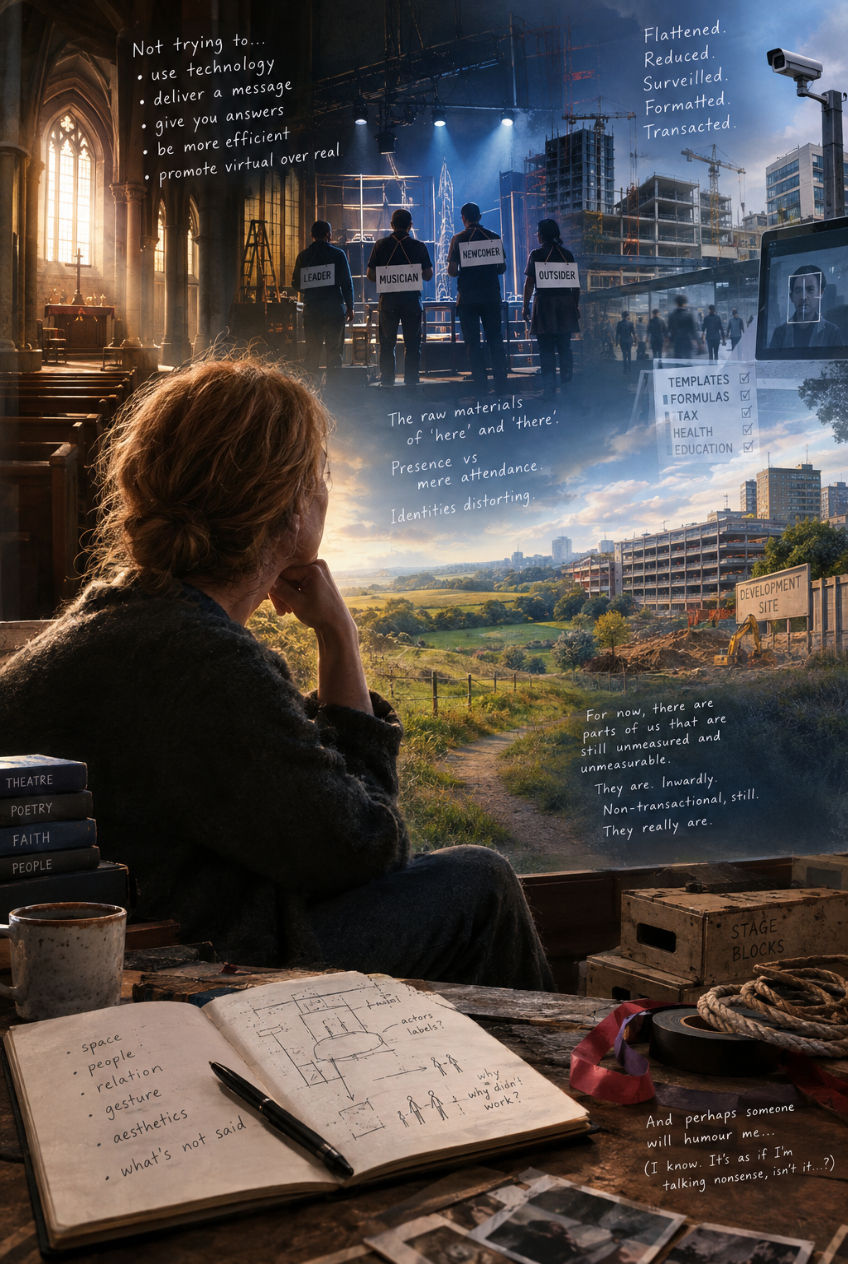
6. Flattening
When we decide the categories are MORE IMPORTANT than the reality, that's when we stop seeing dogs, never imagine cats can be unwell, and assume that cats being herded act exactly in character as they do when they are not being herded. (To make sense of that see point 5. Or read on for something more straightforward.)
Example: We decide to think about sunsets.
A. Clouded ones. And B. the ones that take our breath away.
Me: But this sunset wasn't either of those. This one made me feel nostalgic!
It: Ah, okay. That goes in the 'breath-taking' column, then. Sorted.
Me: But—
It: Trust me. That's how it has to work. We're dealing with over three hundred thousand people here. Keep nostalgia as your own thing.
Me: Well, but—
It: Perhaps what you're actually learning here is that what you call nostalgia is a form of 'breath-taking' and is more properly described as such.
Me: Hmm, but—
It: We can't just create a million new categories, or else our systems would not do what they need to do. So why not at least make a choice and see if you can live with it, and you might even notice that the nostalgia-fixation fades in time and you become a happier person, with more to offer the world.
7. The Unrecognised Good
There may be things that are genuinely good, and life-giving, and theologically significant — perhaps a kind of free gift in plain sight.
In some ways it might even be a great thing that no-one has labelled it yet, because we have a tendency to turn things into products and categories and make those things work hard until they choke, so we can reap rewards.
But while they are unrecognised — for the above reasons — someone might automatically assume bad things:
rebellion
back-sliding
breach of social expectation
That's where, perhaps, the arts come in, for example.
Testing the ground. Legitimately so.
But what about the rest of life.
The rest of us, or them.
8. Oxygen and Over-caution
But if institutional caution starts to cut off the necessary oxygen for what it cannot recognise (or recognise as good) then genuinely and profoundly good motives can be mistrusted and actively defended against.
And then what happens to things like:
trust, play, creativity, imagination, encounter, intimacy?
To faith.
And presence.
9. Boundaries
Of course we need boundaries. Naming things. Healthy leadership.
But things can get smuggled in — like, the idea that those boundaries and rulings are ultimate.
The truth is, the boxes for the cats (see point 5) are only trying to help us herd cats.
If it turns out herding cats in that way not the real point after all, the boxes aren't much use any more.
The boxes are needed, necessary even, when they're doing a particular job.
But they're only as useful up to a point.
They don't suddenly become integral to reality itself.
10. Functional idolatry
The concern, theologically, is when we can end up allowing something to become a non-negotiable, when it was never supposed to be.
Effectively worshipping the containers, rather than realising the containers were only introduced to help support something else we were dealing with.
11. Kaleidoscopic
In my project I'm creating a kind of kaleidoscope that allows things to happen in unexpected configurations.
It gives the appearance of doing the heavy lifting, just as a kaleidoscope seems to make the tiny plastic forms weightless and floating.
But that's only because of transparent architecture that lets the light shine through the physics. The limits are visible, proportionate and open to examination where they are contingent.
Limits that cannot be questioned, such as the external construction of the kaleidoscope (as opposed to its internal moving parts), are down to this author's simple human act of holding, in this particular project iteration.
In other words, this is the narrative Chapter Seventeen logic, which incorporates the inherent value system held by the author as a creator and human.
12. Fictional Characters in the Chapter Seventeen World
In Chapter Seventeen, the Keyholder has keys, but not enough for every door. He's sweeping and opening, and acting as a mediator and facilitator, but doesn't have answers.
He'll point you to the Architect, who is elusive but makes his plans available.
And there's a Waiter with a specials board and a way of greeting that is present and personal but distant enough to not really engage.
But then there's the Author.
One foot in and one foot out of this environment.
Podcast, blogposts, interaction with visitors.
But also wanders.
With the Author, you get transparent conversations around what's happening, why, and why not. That way questions of authority, knowledge and interpretation are made visible.
13. Anything Does Not "Go"
This is not a project in relativism. Not everything is true or equally significant.
God isn't represented by the Author, the Architect, or the Waiter or the Keyholder, not the visitors or residents, nor even the sum of all things.
Contingencies can be seen as contingent, not mistaken for ultimacy.
God's ultimacy — is presumed; our human forms and ways of organising remain contingent.
They may be necessary as the human-sized doorway and plumbing, valuable as priceless ornamentations and our shared access to them, and even beautiful as the subtle lighting and exquisite live music — but they are not God.
(Sometimes silence, darkness, closed doorways and dry land is integral to an encounter with God. Taking everything off the table, to see the table.)
14. Renewed Encounter
Chapter Seventeen isn't manufacturing, enacting, or representing encounter. If it did it would be trying to take the place of the real thing.
But it is offering vantage points — to remove or rearrange contingent barriers, allowing people to collaborate in creative forms of encounter and conversation, drawn and inspired by normally unrecognised goods, and allowing all things to be self-critiqued and examined.
15. What Practice Can Discover That Abstract Argument Cannot
Chapter Seventeen becomes a practice-based theological experiment. Its failures, problems, and unintended consequences are part of what the practice reveals.
Still thinking aloud…